
12th Mar 2026
Why are tiles not flat?
Why Some Tiles Are Not Perfectly Flat
Customers sometimes ask why certain tiles are not perfectly flat. The short answer is that a small amount of curvature can occur in ceramic and porcelain tiles during manufacturing, and this is recognised across the tile industry.
Tiles are made from natural materials that are pressed and fired in kilns at temperatures often exceeding 1200?C. During this firing process, tiles shrink and harden. Because of this, minor variations in flatness or slight curvature can occur, particularly in larger or rectangular tiles.
International manufacturing standards allow tolerances for these variations, and modern quality control ensures most tiles remain well within acceptable limits.
When Tile Curvature Becomes Noticeable
In many installations, this natural curvature is not visible.
However, it can become more noticeable when rectangular tiles are laid in a 50% brick (running bond) pattern. In this layout, the centre of one tile aligns with the ends of adjacent tiles, which may highlight any slight curvature and result in a height difference between tiles known as lippage.
Industry guidance therefore often recommends reducing the offset to around 25–33%, which helps minimise the possibility of high and low points meeting.
Recommended Tile Layouts
For large format or plank tiles, the following layouts typically provide the best result:
- Maximum 33% offset brick pattern
- Stacked (straight lay) pattern
- Random offset patterns
- Use a Tile Levelling System
This reduces the chance of the centre of one tile meeting the end of another tile.
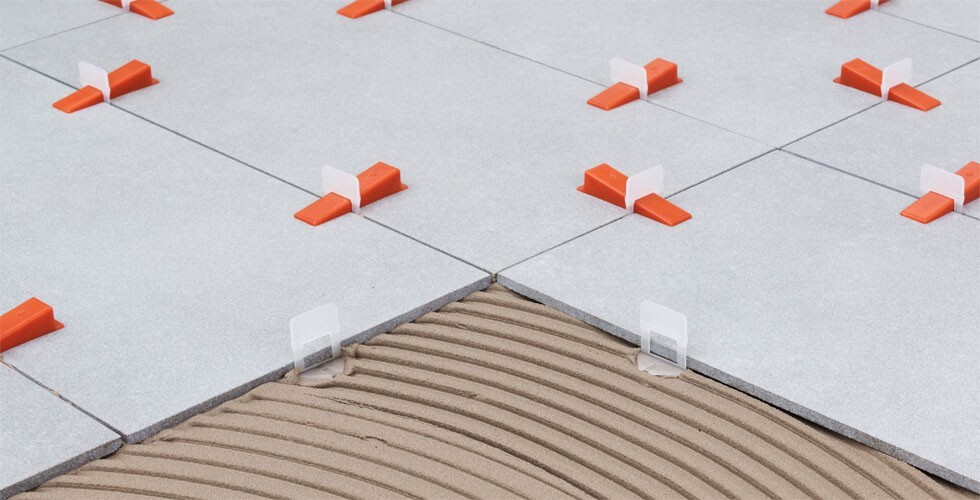
The Role of Tile Levelling Spacers
Professional installers commonly use tile levelling spacers when installing large format tiles.
These systems help:
- Hold adjacent tiles at the same height
- Reduce the risk of lippage
- Maintain a flat, even surface while the adhesive cures
Levelling systems are widely regarded as best practice for installing large format tiles.
Industry Standards
Installation of ceramic and porcelain tiles in Australia and New Zealand is guided by AS 3958.1, which provides guidance on acceptable tolerances, substrate preparation and installation methods.
Following manufacturer recommendations and the AS 3958.1 tiling standard helps ensure the best finished result.
The Key to a Great Tile Installation
Achieving a flat, high-quality tiled surface depends on several factors:
- Correct tile layout patterns
- Properly prepared substrates
- Use of professional installation techniques
- Levelling spacers when installing large tiles
When installed correctly and in accordance with recognised standards, ceramic and porcelain tiles provide a durable, long-lasting and visually attractive surface.